The SOUTH AFRICAN Entry Kit to buying property in a company
Are you frustrated watching others make money with investment properties in a company name?
Struggling to understand how they bypass personal bank limits?
Or how to buy without a massive cash deposits?
All whilst stopping SARS from inheriting 45% of their profits?
Takes 60 seconds. No fluff, just the exact company framework Michael used to make R500 000.
THE SYSTEM IS BUILT TO KEEP YOU CAPPED
You believe the banking system is rigged to keep individual buyers capped at their affordability ceiling. You are right.
They look at your personal income, draw a line, and tell you that is all you get. But your asking the wrong questions
The fear of remaining forever small is real, but the release is understanding this is a design flaw of the Landlord state, not a personal failure. You are playing the wrong game... one which is designed for you to lose.
The tax codes are weaponised against personal names, but they are a playbook for companies. Stop buying in your own name.
This Is Where I See
People Getting It Wrong
If your property Investing is done in your personal name, you’ve already lost.
Most South African investors make one fatal, beginner mistake:
They Buy property like consumers, not like Professionals.
On paper it feels simple. In reality, you’ve just invited SARS, creditors and the Master’s Office into every deal you’ll ever do, and here is what happens:
Banks view you as their asset and limits the amount of properties you can buy
When you become their asset, the property in your personal name becomes your liability. You own a mortgage and become the slave to it
Banks view you as A liability and limits how much you can afford based on what you earn
SARS views you as their asset to tax the hell out of you!
One legal claim can drag your family home and personal assets into the fight. – a tenant injury, a bond default, a business dispute
You leave Section 13SEX tax advantages on the table because your structure screams "small-time consumer" to the tax code - Say goodbye to the 55% tax write off's that are available to us all
In a volatile South African economy, you become the shock absorber. Every rate hike, every vacancy, every misstep hits you personally & Financially
When you die, SARS and your bank all get a say before your children do... and pass that bill onto them
What happens if you keep buying in your own name?
When the market is up, it feels harmless. Transfers go through, tenants pay, life is good.
But structurally, every new property in your personal name tightens the noose.
You can of course transfer it later, but that comes with it's own set of challenges.
WHO THIS IS FOR
PROFILE 01
Anet: SALARIED, OWNS NO INVESTMENT PROPERTY... Yet
Your blocker is belief, not knowledge. You fear you cannot enter the market, but the release is seeing a R500,000 profit in 12 months on a R1.6m Pretoria property secured for R1.1m.
THE DIRECTORS ENTRY KIT
PROFILE 02
THABO: OWNS 1-3 PROPERTIES, HIT AFFORDABILITY CEILING
Your blocker is shame plus not knowing if it is fixable. You fear being stuck forever, but the release is knowing you can own a R31 million building with R0 of your own money through correct structuring.
THE DIRECTORS ENTRY KIT

THE FOUNDER'S STORY
MORE FAILURES
THAN SUCCESSES
I will be completely honest with you: By count, I have had far more property failures than successes. By count.
I bought the wrong deals in my personal name, trusted the wrong partners, and lost money I could not afford to lose. It is my embarrassing reality of playing the game without knowing the rules.
But, this is also the truth: By profit, my structured successes are 100x more successful than the losses!
Whilst 3 properties lost me R70K one year, 1 property netted me over R500K the very next year.
When I finally stopped chasing "hot deals" and started focusing entirely on legal and financial structure, everything shifted. Today, I own a R31 million building with R0 of my own money in it. Not because I got lucky, but because the acquisition was structured correctly from day one.
You can either learn these lessons the hard way through devastating and embarrassing losses, or you can learn the framework that makes the losses irrelevant and the wins exponential.
PS. The 70K losses were written off as Tax deductions the following year.
If you want to bypass 10 years of failures, the countless mistakes, and the sleepless nights, then get your entry kit today.
Are you ready to build a property portfolio without maxing out your personal bank loans?
The Directors entry Kit doesn’t just teach you how to buy a two bedroom in Sandton or Camps Bay - It shows you how to own nothing, control everything – so SARS, creditors and business partners never get the master keys to your wealth.
What does the Entry Kit share with you:
How to overcome the "I need three years of financials to buy in a company" Lie so you can buy property in a company name.
How to remove the blocker of the 'I don't have a massive cash deposit or personal affordability' lie—so you can leverage the bank's money instead of yours
How to separate and shield your personal life from your property businesses so a single bad tenant can’t touch your family home.
How to protect your family from the Estate Duty Trap and not be forced to sell properties just to pay the government when you’re gone.
The thought buster that helped me realize why personal ownership is a poor mans mindset and trap!
Automation-Ready: How the right structure lets you hand operations to a team without losing control or it costing you much.
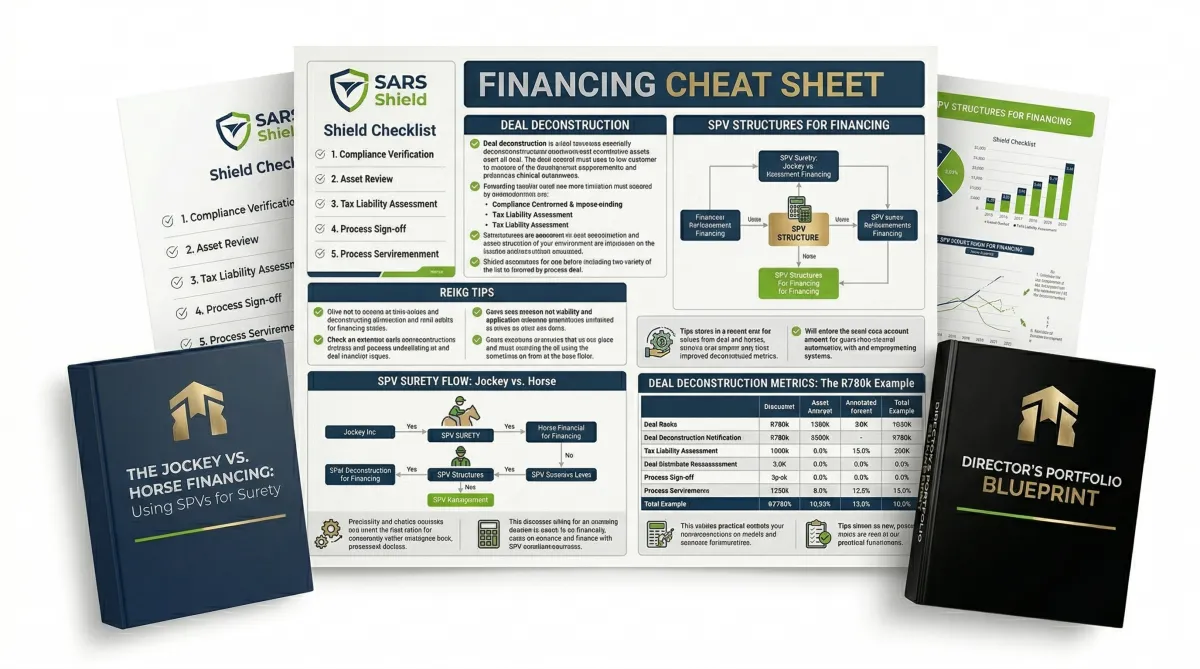
Drop your details below to access the exact Entry Kit Michael uses to ring-fence his portfolio from SARS, Estate Duty and Operational risk.
Takes 60 seconds. No fluff, just the framework Michael uses to build portfolios designed to outlive their owners.
This protocol is free.
The price of not using it is not.
One poorly structured portfolio can bleed more to SARS and Creditors than an entire lifetime of "good deals" can fix. Estate Duty doesn’t care how hard you worked. The law only respects how you structured what you built.
Frequently asked by serious investors:
Can I move a property I already own into a company?
Yes — and it's one of the most important questions in property structuring in South Africa. The short answer involves two very different routes with very different costs. We go deep on this inside The Vault, but start here: understand the company structure first, because you need to know where you're moving to before you worry about the move.
Will this apply If I can't get a mortgage?
Yes, there are many ways to secure properties without needing a mortgage. Installment sales agreements are one such example where you take over the existing home owners bond. We have done this without any credit checks or mortgages.
I want a partner who will stand surety for the mortgage whilst i do all the work...
Partnerships in your own names are a recipe for loosing everything! Companies provide legal frameworks to protect both sides and are teh only way I partner!
Can I register a bond at 1.5 x higher than the property value in a company name
Yes. It's exactly what I do, and what you need to ask your mortgage originator to do for you. If they don't, use mine - His contact details are in the directors fortress.
Does it cover Section 13sex opportunities?
Yes – at a strategic level. The protocol highlights how you implement Section 13sex to supercharge it in the right structure.
Is this just another generic "property investing eBook"?
Fuc# No. The Company Name Protocol is not about area selection, bond applications or "finding deals". It focuses narrowly on how you can buy in a company name so that SARS, creditors and the Master’s Office have as little leverage as possible over your portfolio.
Will this replace my attorney or tax practitioner?
It won’t – and it shouldn’t. This protocol equips you to walk into those meetings with a clear, investor-grade brief instead of hoping your service providers "get it". You’ll understand the high-level structure to request and the red flags to avoid.
Is this only relevant if I’m already wealthy?
No. The best time to design a fortress is before you’ve filled it with assets. Whether you own one unit or twenty, the structural moves you make now can determine how much SARS, creditors and future partners will be able to touch.
Stop Sitting on the sidelines or buying property in your personal name.
In South Africa, If you are a Property Spectator or a Landlord -
You are loosing the most!
Engineered for South African investors who are done playing small and ready to architect a portfolio the boardroom would respect.